When using artificial intelligence in businesses, we are not only interested in how well AI can answer a question. Much more interesting is whether it can independently carry out a concrete business process.
That is why we conducted a practical test connecting Hermes Agent with InteliDoc.
We provided the agent with a PDF of a received invoice and the following instruction:
Read the document, import it into InteliDoc, add the original PDF file to the invoice, and link it to the corresponding supplier folder in the project.
From that moment on, the process was executed by the AI agent.
What Did the AI Agent Do Itself?
Hermes Agent first analyzed the content of the PDF invoice and identified key data from the document. Among other things, it identified the supplier GEN-I, d.o.o., the invoice number, and the amount.
It then checked via the InteliDoc API whether the organization already existed in the system. It found the supplier based on its tax number and used the existing record instead of creating a new one.
This was followed by the actual invoice import into InteliDoc. The agent created an incoming invoice record, attached the original PDF as an attachment, and linked the document to the project.
Finally, it searched the project structure for the Suppliers → Invoices folder, found the corresponding supplier subfolder, and linked the invoice to it.
The entire process – from unstructured PDF document to properly recorded and classified invoice – was performed automatically.
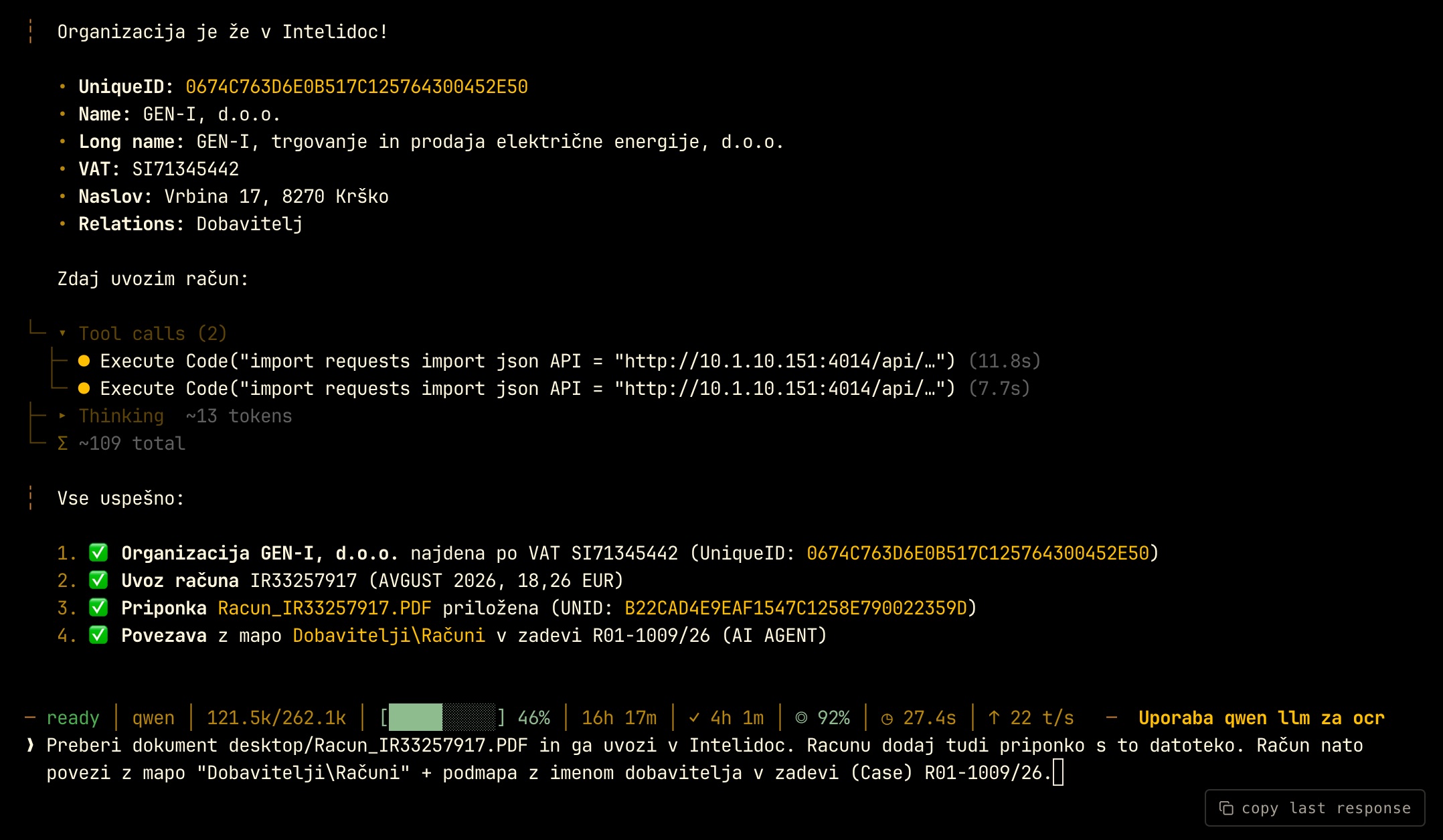
Hermes Agent independently reads a PDF invoice, identifies the supplier, and performs the required operations via the InteliDoc API.
The Result Is Visible Directly in InteliDoc
After the process was completed, the invoice was visible in the project in the correct location:
Suppliers → Invoices → GEN-I, d.o.o.
Along with the invoice, the original PDF file was also saved.
This is an important difference between classical generative AI usage and an AI agent. The agent did not just say what should be done. It actually carried out the required steps via the API.

Result of the automated process in InteliDoc: the received invoice and original PDF file are linked to the corresponding supplier and project folder.
From Document to Business Process
The invoice example is relatively simple, but it shows a broader use case.
If a business application has a well-defined API, the AI agent can be given controlled functions such as searching data, creating documents, adding attachments, linking documents to projects, or performing other permitted operations.
This way, we can similarly process:
- incoming invoices and delivery statements,
- contracts and addendums,
- warranties,
- purchase orders and delivery notes,
- project correspondence,
- meeting minutes,
- quotations, and other project documentation.
The key advantage is that the document does not just need to be recognized. AI can, based on its content, trigger and execute the next steps of a business process.
InteliDoc API as the Link Between AI and Business Data
A large language model by itself does not know the business system and should not have direct access to its data.
This is where the InteliDoc API comes in.
Through defined API operations, the agent can access only the functions it needs. InteliDoc remains the system where documents, projects, organizations, and business data are stored, while the AI agent becomes an additional intelligent layer that knows how to use these functions.
In our example, the chain was simple:
PDF invoice → AI understands the document → InteliDoc API → business data → project documentation
Such an architecture enables AI to be used not as a separate chatbot, but as part of an actual business process.
The Next Step: From Command to Full Automation
In the example shown, the user gave the agent an instruction to process a single invoice.
The next step is to eliminate even this manual effort.
A received document can trigger the process automatically. The AI agent analyzes it, identifies the document type and business data, finds the corresponding project or partner, and carries out the intended procedure via the InteliDoc API.
Humans can then only get involved where a decision or confirmation is needed.
This is the direction in which we see practical AI usage in business systems: not just answering questions, but understanding documents and carrying out concrete business processes.